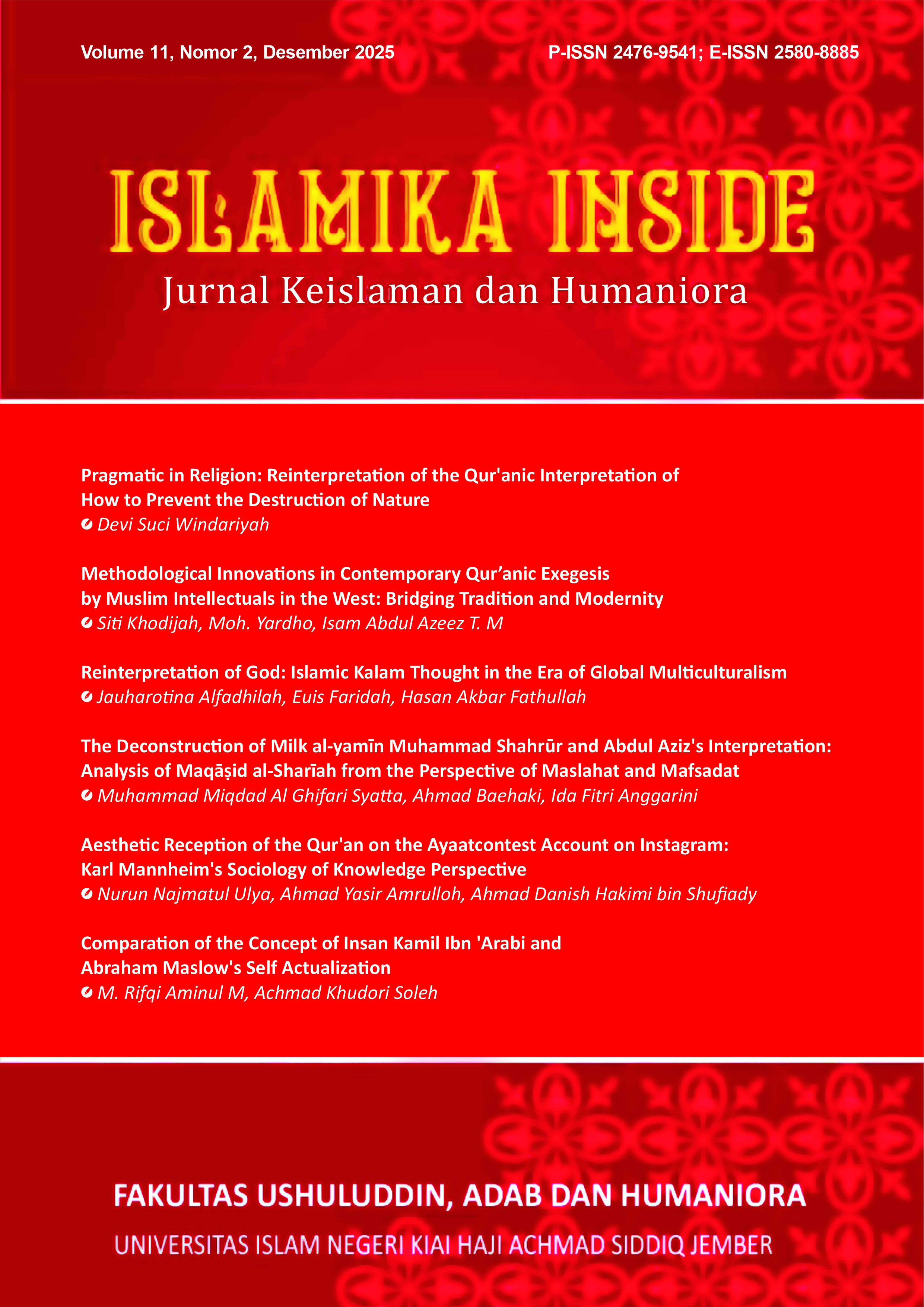
Comparation of the Concept of Insan Kamil Ibn 'Arabi and Abraham Maslow's Self Actualization
DOI:
https://doi.org/10.35719/islamikainside.v11i2.295Keywords:
al-Insān al-Kāmil, Self Actualization, Ibn 'Arabi, Abraham MaslowAbstract
This research aims to comparatively analyze the philosophical spiritual dimension of Ibn ‘Arabi’s concept of insan kamil and the humanistic–psychological dimension of Abraham Maslow’s theory of self-actualization, particularly in relation to their views on the meaning of life and human perfection. This study is significant as it explores how these two frameworks rooted in Islamic metaphysics and modern humanistic psychology offer distinct yet potentially complementary perspectives for addressing the challenges of achieving existential balance and authentic self-actualization in the modern era. This research aims to identify the similarities and differences between the concepts of insan kamil and self-actualization and how they are applied in life. The research method uses qualitative with a literature study approach which involves content analysis from several literature sources. Results of this research; 1) perfect human being tajalli God and fully practice the teachings of the Prophet Muhammad. 2) Self-actualization as a peak experience provides psychological and physiological mystical experiences as well as an expanded outlook on life. 3) The combination of human beings with self-actualization provides a deep understanding of oneself, spiritual experience, social responsibility, and understanding of human dignity. 4) This research contributes to academic literature and can be a guide for psychological and spiritual self-development.
References
’Arabi, M. I. (1911). Futhuhat al Makkiyah (Jilid II). Daru Shadir
Ahdiani, U., & Maulana, A. (2023). Abraham Maslow’s hierarchy of human needs building self-actualization reflected in a Broken Home child character. NOTION: Journal of Linguistics, Literature, and Culture, 5(2), 151–168. https://doi.org/10.12928/notion.v5i2.8559
Ahmad Rizal, D. (2020). Konsep Manusia Sempurna Menurut Pandangan Friedrich Williams Nietzsche Dan Ibnu Arabi; Sebuah Analisa Komparatif. Refleksi Jurnal Filsafat Dan Pemikiran Islam, 20(1), 69–83. https://doi.org/10.14421/ref.v20i1.2306
Albimawi, H., Tobroni, & Moh. Nurhakim. (2023). Human Nature in the View of the Qur’an and Ibn Arabi. International Journal of Health, Economics, and Social Sciences (IJHESS), 5(3), 270–277. https://doi.org/10.56338/ijhess.v5i3.3829
Ali, I. (2017). Nilai-nilai Dasar Pendidikan Tasawuf dalam Paradigma Mistik Ibnu ’Arabi Tentang Insan Kamil. El-Furqania : Jurnal Ushuluddin Dan Ilmu-Ilmu Keislaman, https://ejournal.kopertais4.or.id/madura/index.php/elfurqania/issue/view/694. https://doi.org/https://doi.org/10.54625/elfurqania.v3i01.2758v
al-Jili, A. K. bin I. (1975). al-Insan al-Kamil fi Ma‘rifah al-Awakhir wa al-Awa’il. Dar al-Fikr.
Alwisol. (2019a). Psikologi kepribadian (edisi revisi). Universitas Muhammadiyah Malang, 1(2011).
Annajih, Moh. Z. H., Sa’idah, I., & Taufik. (2023). Konsep Self-actualized Abraham Maslow: Perspektif Psikologi Sufistik. Edu Consilium : Jurnal Bimbingan Dan Konseling Pendidikan Islam, 4(1), 43–52. https://doi.org/10.19105/ec.v4i1.7282
Arroisi, J., & Badi’, S. (2022). Konsep Harga Diri: Studi Komparasi Perspektif Psikologi Modern dan Islam. Psikologika: Jurnal Pemikiran Dan Penelitian Psikologi, 27(1), 89–106. https://doi.org/10.20885/10.20885/psikologika.vol27.iss1.art7
Aslam, F., Akhter, S., & Aslam, N. (2023). Self-Actualization, Individuation and Self-Realization to Search the True Self: A Comparative Study of Siddhartha and a Portrait of the Artist as a Young Man. Pakistan Journal of Humanities and Social Sciences, 11(1), 91–101. https://doi.org/10.52131/pjhss.2023.1101.0332
Center, S. G. S. and R., & Friedman, H. (2002). Transpersonal Psychology as a Scientific Field. International Journal of Transpersonal Studies, 21(1), 175–187. https://doi.org/10.24972/ijts.2002.21.1.175
Charles N. Alexander, Maxwell V. Rainforth, & Paul Gelderloos. (1991). Transcendental Meditation, Self-Actualization and Psychological Health: A Conseptual Overview and Statistical Meta-Analysis. Journal of Social Behavior and Personality, 189–247. https://www.proquest.com/openview/96282a627d15a9e40a80a4c5ea6ccba4/1?pq-origsite=gscholar&cbl=1819046.
Chittick, W. (1989). The Sufi Path of Knowledge; Ibn al-’Arabi’s Metaphysics of Imagination. State University of New York Press.
Chittick, W. C. (2013). Ibn ‘Arabī on the Ultimate Model of the Ultimate. In J. Diller & A. Kasher (Eds.), Models of God and Alternative Ultimate Realities (pp. 915–929). Springer Netherlands. https://doi.org/10.1007/978-94-007-5219-1_76
Davids, N., & Waghid, Y. (2019a). Ibn al-Arabi’s Idea of Al-insan Al-kamil (the Perfect Human) and Democratic Education. In Democratic Education and Muslim Philosophy.
Davids, N., & Waghid, Y. (2019b). Ibn al-Arabi’s Idea of Al-insan Al-kamil (the Perfect Human) and Democratic Education BT - Democratic Education and Muslim Philosophy: Interfacing Muslim and Communitarian Thought (N. Davids & Y. Waghid, Eds.; pp. 71–79). Springer International Publishing. https://doi.org/10.1007/978-3-030-30056-2_7
Frandika, E., & Wachid, A. (2019). Self-Actualization of the Main Characters in the Perempuan Berkalung Sorban by Abidah El Khalieqy: Psychological Study of the Abraham Perspective Maslow Literature.
Gholamnejad, H., Darvishpoor-Kakhki, A., Ahmadi, F., & Rohani, C. (2019). Self-Actualization: Self-Care outcomes among elderly patients with hypertension. Iranian Journal of Nursing and Midwifery Research, 24(3), 206. https://doi.org/10.4103/ijnmr.IJNMR_95_18
Guan, Y., Du, L., Yang, C., & Hu, H. L. (2025). Exploring the roles of self-actualization, language self-efficacy, and academic emotions in EMI students’ achievement: a structural equation modeling approach. Frontiers in Education, 10. https://doi.org/10.3389/feduc.2025.1567143
Hadaegh, B. (2012). A Comparative Study: Self-Realization in Twentieth-Century Western Thought, Ibn e Arabi’s Idea, and Theatre of The Absurd. K@ta: A Biannual Publication on the Study of Language and Literature, 13(2), 188–201. https://doi.org/10.9744/kata.13.2.188-201
Hadori, M. (2015). AKTUALISASI-DIRI (SELF-ACTUALIZATION); SEBUAH MANIFESTASI PUNCAK POTENSI INDIVIDU BERKEPRIBADIAN SEHAT (Sebuah Konsep Teori Dinamika-Holistik Abraham Maslow) 1 (Vol. 9, Issue 2).
Hasyim, M. (2022). Insan Kamil. Ensiklopedi Islam. https://ensiklopediaislam.id/insan-kamil/
Ibn ’Arabi. (1980). Fusus al-Hikam, Abu al-’Ala ’Afifi (1st ed.). Dar al-Kitab al-’Arabi.
Khamid, K. (2017). Wahdat Al Wujud Dan Insan Kamil Menurut Ibnu Al Arabi. https://www.academia.edu/97247711/Wahdat_Al_Wujud_Dan_Insan_Kamil_Menurut_Ibnu_Al_Arabi
Lala, I. (2023). Trauma and the Emergence of Spiritual Potentiality in Ibn ’Arabī’s Metaphysics. Religions, 14(3). https://doi.org/10.3390/rel14030407
Lavrova, L., Savchenko, V., & Hirlina, N. (2023). SELF-ACTUALIZATION AND SELF-REALIZATION AS EDUCATIONAL PRIORITIES OF THE NEW UKRAINIAN SCHOOL. Dnipro Academy of Continuing Education Herald. Series: Philosophy, Pedagogy, Vol. 1 No. 1 (2023), 62–67. https://doi.org/10.54891/2786-7005-2023-1-10
Maslow, A. H. (1943). A theory of human motivation. Psychological Review, 50(4), 370–396. https://doi.org/10.1037/h0054346
Maslow, A. H. (1954). Motivation and personality. In Motivation and personality. Harpers. files/124/1955-02233-000.html
Maslow, A. H. (1992). The Power of Self-Actualization (1st ed.). Audiobook Published.
Miri Sayyed Mohsen. (2004). Sang Manusia Sempurna; Antara Filsafat Islam dan Hindu (Zubair, Trans.; Cet. 1). Teraju.
Morris, J. W., Chittick, W. C., & al-’Arabi, I. (1991). The Sufi Path of Knowledge: Ibn al-’Arabi’s Metaphysics of Imagination. Journal of the American Oriental Society, 111(3). https://doi.org/10.2307/604289
Nasiruddin, M., & Fitriani, L. (2023). Nilai dan Makna Spiritualitas dalam Kitab Futuhat Makiyah Karya Ibnu ’Arabi: Analisis Psikologi Dakwah. Dakwatuna: Jurnal Dakwah Dan Komunikasi Islam, 9(2). https://doi.org/10.54471/dakwatuna.v9i2.2423
Netton, I. R. (1996). Imaginal worlds: Ibn al-‘Arabī and the problem of religious diversity. By William C. Chittick. (SUNY Series in Islam.) pp. vii, 208. Albany, State University of New York Press, 1994. US$18.95. Journal of the Royal Asiatic Society, 6(1), 90–91. https://doi.org/10.1017/S135618630001484X
Pandey, P. S. (2023). Self-Actualization Tendencies in Interpersonal Relationships in Philip Roth’s The Professor of Desire. Comparative Literature: East & West, 7(1), 33–43. https://doi.org/10.1080/25723618.2023.2225307
Pausanos, M. (2016). Predictors of Self-Actualization. ACADEME University of Bohol, Graduate School and Professional Studies, 8(1), 12–31. https://doi.org/10.15631/aubgsps.v8i1.99
Popova, I. N. (2023). Self-actualization of Children in Difficult Life Situations. In S. G. Maximova (Ed.), Complex Social Systems in Dynamic Environments (Vol. 365, pp. 909–917). Springer International Publishing. https://link.springer.com/10.1007/978-3-031-23856-7_78
Pow, S., & Stahnisch, F. (2014). The Organism: A Holistic Approach to Biology Derived from Pathological Data in Man by Kurt Goldstein. Journal of the History of the Neurosciences, 23, 330–332. https://doi.org/10.1080/0964704X.2013.860512
Rifa’i, M. K. (2016). INTERNALISASI NILAI-NILAI RELIGIUS BERBASIS MULTIKULTURAL DALAM MEMBENTUK INSAN KAMIL. Jurnal Pendidikan Agama Islam, 4(1), 117–133. files/201/Rifa - 2016 - INTERNALISASI NILAI-NILAI RELIGIUS BERBASIS MULTIK.pdf
Rifkiana, S., & Subaidi. (2022). PSIKOLOGI TRANSPERSONAL, DISCOURSE IMPLEMENTATIF DALAM MEMBANGUN KARAKTER. Risalah, Jurnal Pendidikan Dan Studi Islam, 8(1), 431–440. https://doi.org/10.31943/jurnalrisalah.v8i1.201
Rogers, C. R. (1942). Counseling and psychotherapy; newer concepts in practice. In Counseling and psychotherapy; newer concepts in practice. Houghton Mifflin.
Rotter, J. B., Chance, J. E., & Phares, E. J. (1972). Applications of a social learning theory of personality. In Applications of a social learning theory of personality. Holt, Rinehart & Winston. files/122/1973-26852-000.html
Downloads
Published
How to Cite
Issue
Section
License
License and Copyright
Authors who publish in this journal agree to the following terms:
- Authors retain copyright and grant the journal right of first publication with the work simultaneously licensed under a Creative Commons Attribution-ShareAlike 4.0 International License that allows others to share the work with an acknowledgement of the work's authorship and initial publication in this journal.
- Authors are able to enter into separate, additional contractual arrangements for the non-exclusive distribution of the journal's published version of the work (e.g., post it to an institutional repository or publish it in a book), with an acknowledgement of its initial publication in this journal.
- Authors are permitted and encouraged to post their work online (e.g., in institutional repositories or on their websites) prior to and during the submission process, as this can lead to productive exchanges and earlier and greater citation of published work.
Read more: License and Copyright