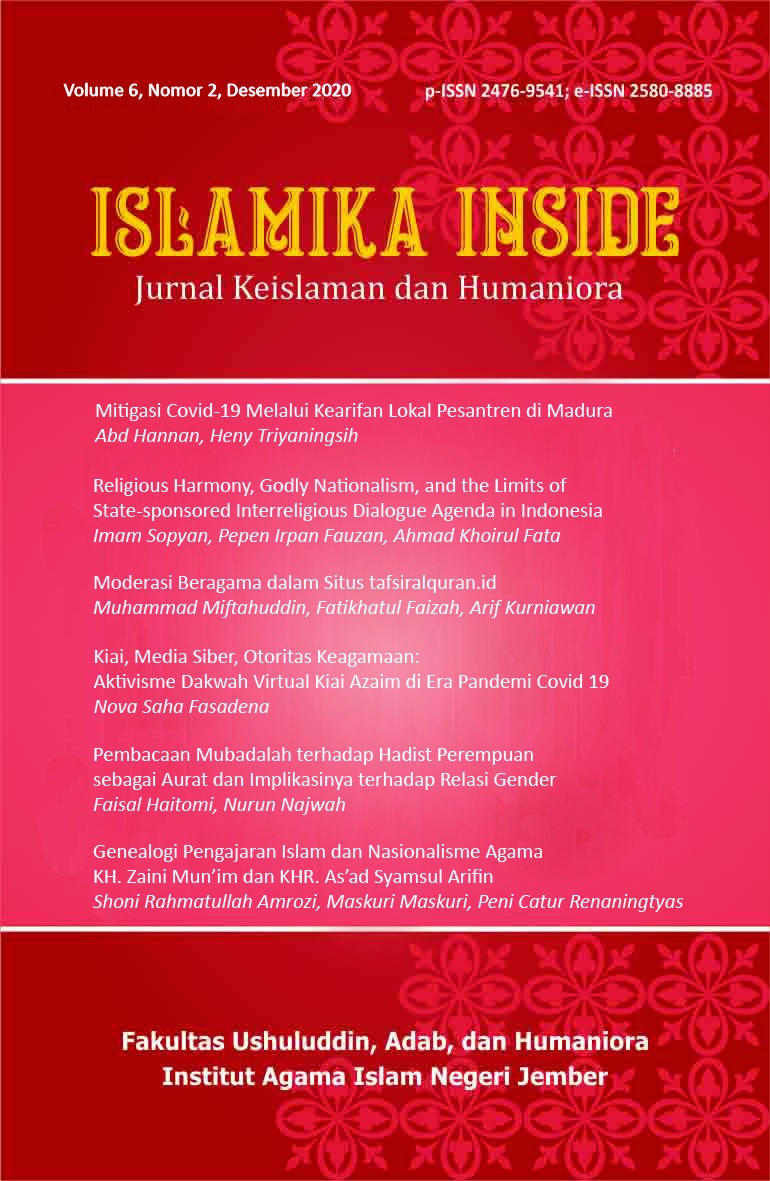
Pembacaan Mubadalah terhadap Hadist Perempuan sebagai Aurat dan Implikasinya terhadap Relasi Gender
DOI:
https://doi.org/10.35719/islamikainside.v6i2.105Keywords:
Interpretation, Mubadalah, Gender RelationsAbstract
Abstract: This paper discusses the discourse on gender equality which is a hot issue to date. This research uses the mubadalah approach (annoyance/cooperation) which was initiated by Faqihuddin Abdul Kodir as an analysis tool. In the meantime, this research is focused on answering how the interpretation of mubad is from the hadith which is the object of this research. From the discussion presented, this research concluded that the editorial hadith about women as genitals which was later understood as the theological basis for housing women was not appropriate, because the main idea of this hadith is not that of keeping the soul (Hifz Nafs), protecting the offspring (Hifz an-Nasl) and safeguarding property (Hifz al-Mal). Therefore, from the main idea of the above hadith, it is concluded that it is not only women who are recommended to guard these three things, men on the other hand are also charged with the same responsibility.
Downloads
Published
How to Cite
Issue
Section
License
License and Copyright
Authors who publish in this journal agree to the following terms:
- Authors retain copyright and grant the journal right of first publication with the work simultaneously licensed under a Creative Commons Attribution-ShareAlike 4.0 International License that allows others to share the work with an acknowledgement of the work's authorship and initial publication in this journal.
- Authors are able to enter into separate, additional contractual arrangements for the non-exclusive distribution of the journal's published version of the work (e.g., post it to an institutional repository or publish it in a book), with an acknowledgement of its initial publication in this journal.
- Authors are permitted and encouraged to post their work online (e.g., in institutional repositories or on their websites) prior to and during the submission process, as this can lead to productive exchanges and earlier and greater citation of published work.
Read more: License and Copyright