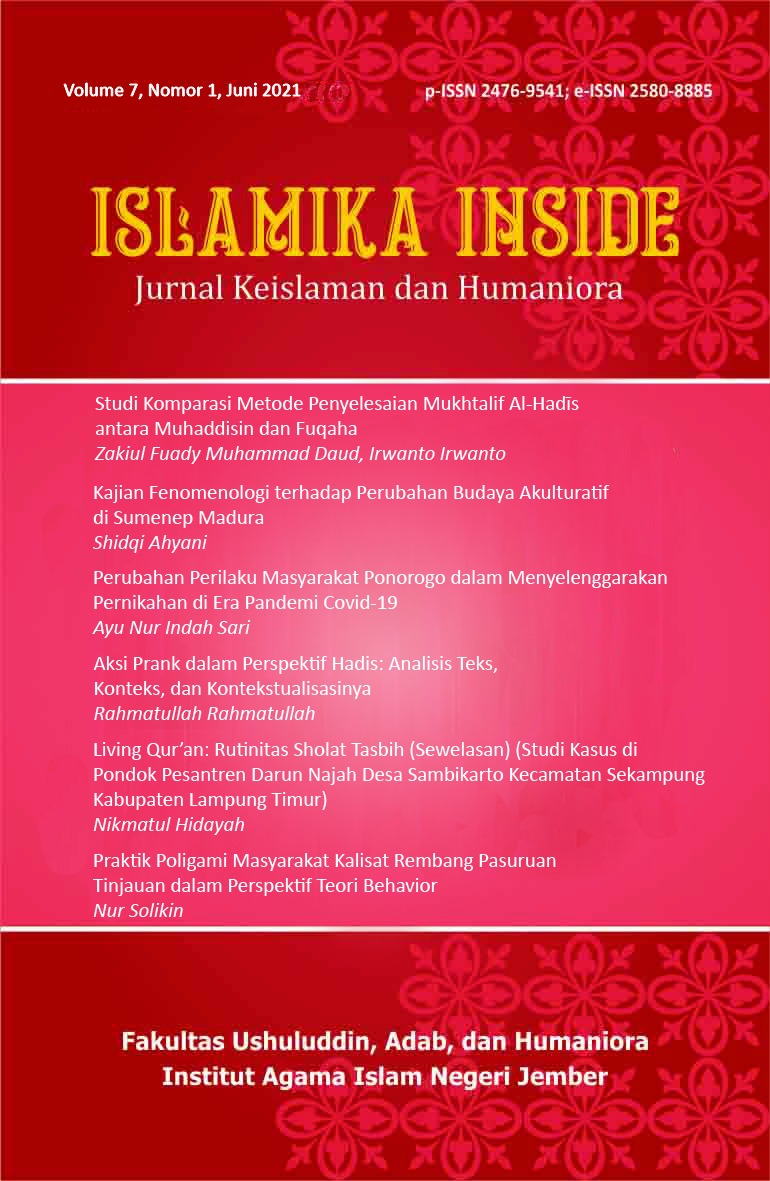
Studi Komparasi Metode Penyelesaian Mukhtalif Al-Hadīs antara Muhaddisin dan Fuqaha
DOI:
https://doi.org/10.35719/islamikainside.v7i1.128Keywords:
contradictory hadith, settlement method, hadith scholar, fiqh scholarAbstract
Abstract: Outwardly, there are hadith that seem contradictory between one hadith and another. It happened not because of the inconsistency of the Prophet Muhammad in giving his words but because of the method of hadith researchers in understanding them. In resolving these contradictory hadiths, there are several methods used by scholars. This paper aims to determine the methods used by hadith scholars and fiqh scholars in completing these hadiths and to compare the methods they use. This research is a literature review using content analysis as a data analysis technique. The results of this study indicate that hadith and fiqh scholars have the same sequence of methods in resolving contradictory hadith, they are al-jam'u (compromising), nasakh (abrogating), tarjih (confirming), and tawaqquf methods (moratorium). Only does Imam Abu Hanifah has a different order, they are nasakh, tarjih, al-jam'u, and tawaqquf. The comparison of the methods used by the two groups of scholars, both hadith and fiqh scholars agreed to prioritize the al-jam'u method as an attempt not to paralyze one hadith with other hadiths. However, in contrast to Imam Abu Hanifah, who prioritized the nasakh method rather than the al-jam'u method, consequently there were hadiths that were not used.
Downloads
Published
How to Cite
Issue
Section
License
License and Copyright
Authors who publish in this journal agree to the following terms:
- Authors retain copyright and grant the journal right of first publication with the work simultaneously licensed under a Creative Commons Attribution-ShareAlike 4.0 International License that allows others to share the work with an acknowledgement of the work's authorship and initial publication in this journal.
- Authors are able to enter into separate, additional contractual arrangements for the non-exclusive distribution of the journal's published version of the work (e.g., post it to an institutional repository or publish it in a book), with an acknowledgement of its initial publication in this journal.
- Authors are permitted and encouraged to post their work online (e.g., in institutional repositories or on their websites) prior to and during the submission process, as this can lead to productive exchanges and earlier and greater citation of published work.
Read more: License and Copyright