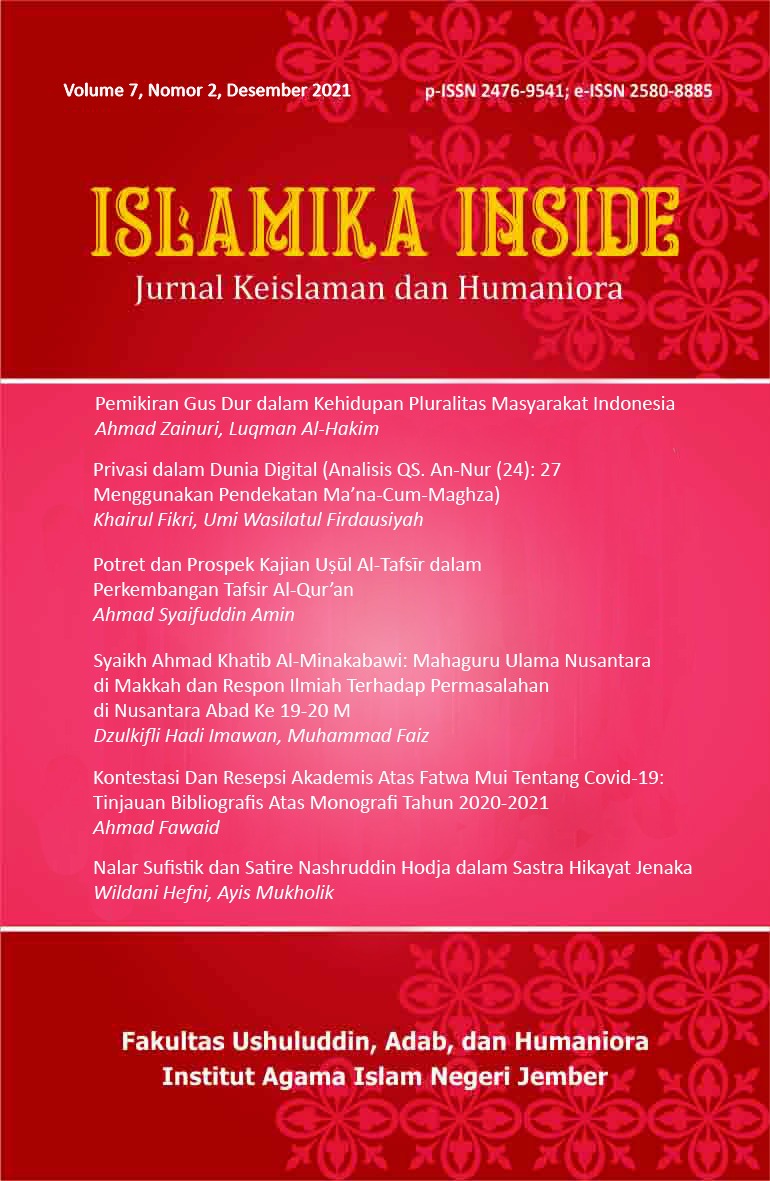
Pemikiran Gus Dur dalam Kehidupan Pluralitas Masyarakat Indonesia
DOI:
https://doi.org/10.35719/islamikainside.v7i2.133Keywords:
Gus Dur, Islam, Humanity, PluralistAbstract
Abstract: Abdurrahman Wahid or often known as Gus Dur, is a nationalist thinker, writer and kyai in Indonesia. His ideas and thoughts have given a glimmer of light to some Indonesian Muslims about the importance of respecting and living tolerance. In his intellectual perspective, the basic foundation for building a pluralistic Indonesia is based on a national cultural and ideological foundation, none other than Pancasila. Because these two foundations build on the history of nationalism, both personally and collectively. Grounding Islam as one of Gus Dur's noble nawacitas to unite the values and norms of religious spirituality, namely the beauty of religion. In this article the author uses a biographical approach. The concept of historical writing: data, facts, sources and methods. With several approaches, concepts and methodologies of historical research, this writing uses a literature review or literature study with several primary and secondary historical sources from Gus Dur's works as well as several other writers who discuss Gus Dur and scientific journals. Gus Dur's thinking is a thought based on pluralism-humanism, Pancasila, Islamic indigenization and Islamic cosmopolitanism.
Downloads
Published
How to Cite
Issue
Section
License
License and Copyright
Authors who publish in this journal agree to the following terms:
- Authors retain copyright and grant the journal right of first publication with the work simultaneously licensed under a Creative Commons Attribution-ShareAlike 4.0 International License that allows others to share the work with an acknowledgement of the work's authorship and initial publication in this journal.
- Authors are able to enter into separate, additional contractual arrangements for the non-exclusive distribution of the journal's published version of the work (e.g., post it to an institutional repository or publish it in a book), with an acknowledgement of its initial publication in this journal.
- Authors are permitted and encouraged to post their work online (e.g., in institutional repositories or on their websites) prior to and during the submission process, as this can lead to productive exchanges and earlier and greater citation of published work.
Read more: License and Copyright