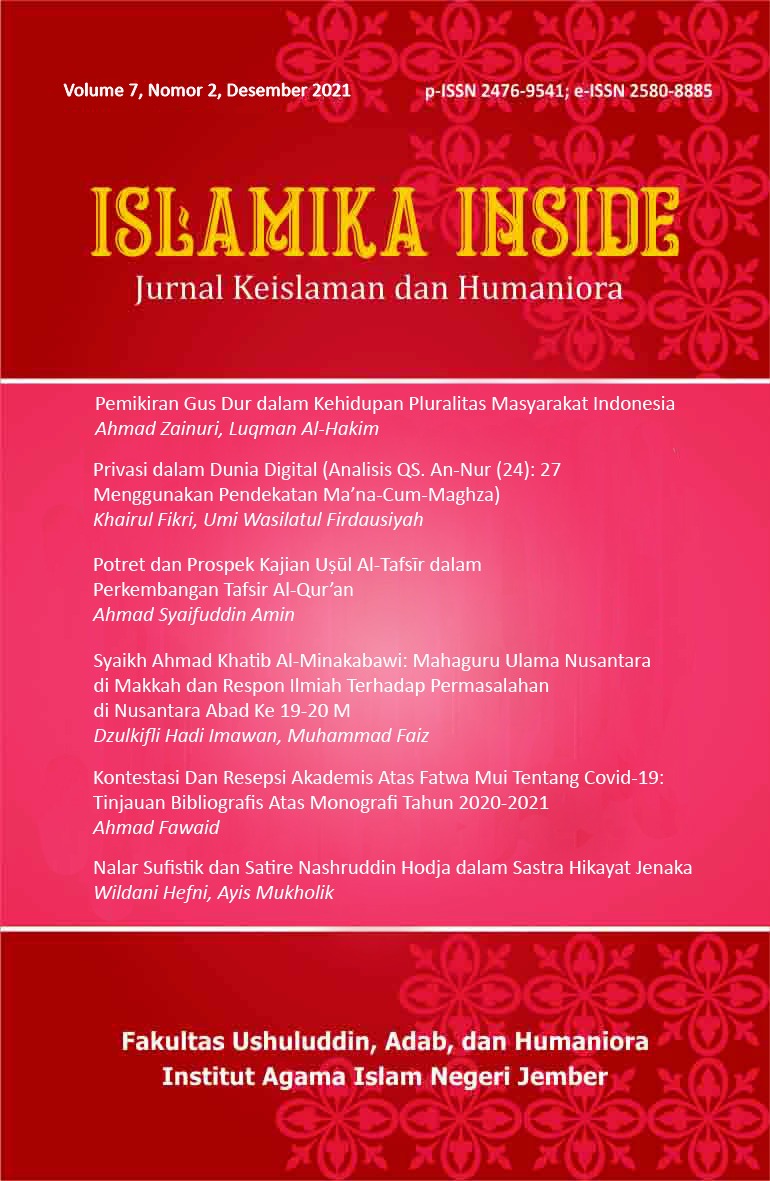
Privasi dalam Dunia Digital (Analisis QS. An-Nur (24): 27 Menggunakan Pendekatan Ma’na-Cum-Maghza)
DOI:
https://doi.org/10.35719/islamikainside.v7i2.135Keywords:
Privacy, Virtual World, Ma'na, MaghzaAbstract
Abstract: Problems that still often arise in social life today are ethical issues, especially in terms of maintaining privacy, both in the real world and in the virtual world (digital). Starting to lose awareness of asking for permission and waning understanding of the boundaries of privacy has the potential to cause various problems and even criminal acts in the future. So it is important to describe how the Qoran teaches adab isti'dzan (asking permission) to take moral values and practice them in life. Through the ma'na-cum-maghza approach, this paper aims to analyze QS. An-Nur (24): 27 regarding how the Qoran talks about the ethics of asking for permission and its relation to maintaining privacy. This is done in order to prove that the Qoran is still shalih li kulli zaman wa makan (relevant for every time and place) and can be used as a reference in solving contemporary problems. The results of this study indicate that the Qoran through QS. An-Nur (24): 27 not only prohibits entering the house without the permission of the owner, but it can also be understood in the current context that it contains a prohibition not to disturb other people's personal data in the digital world so thatcyber crimecan be avoided.
Downloads
Published
How to Cite
Issue
Section
License
License and Copyright
Authors who publish in this journal agree to the following terms:
- Authors retain copyright and grant the journal right of first publication with the work simultaneously licensed under a Creative Commons Attribution-ShareAlike 4.0 International License that allows others to share the work with an acknowledgement of the work's authorship and initial publication in this journal.
- Authors are able to enter into separate, additional contractual arrangements for the non-exclusive distribution of the journal's published version of the work (e.g., post it to an institutional repository or publish it in a book), with an acknowledgement of its initial publication in this journal.
- Authors are permitted and encouraged to post their work online (e.g., in institutional repositories or on their websites) prior to and during the submission process, as this can lead to productive exchanges and earlier and greater citation of published work.
Read more: License and Copyright