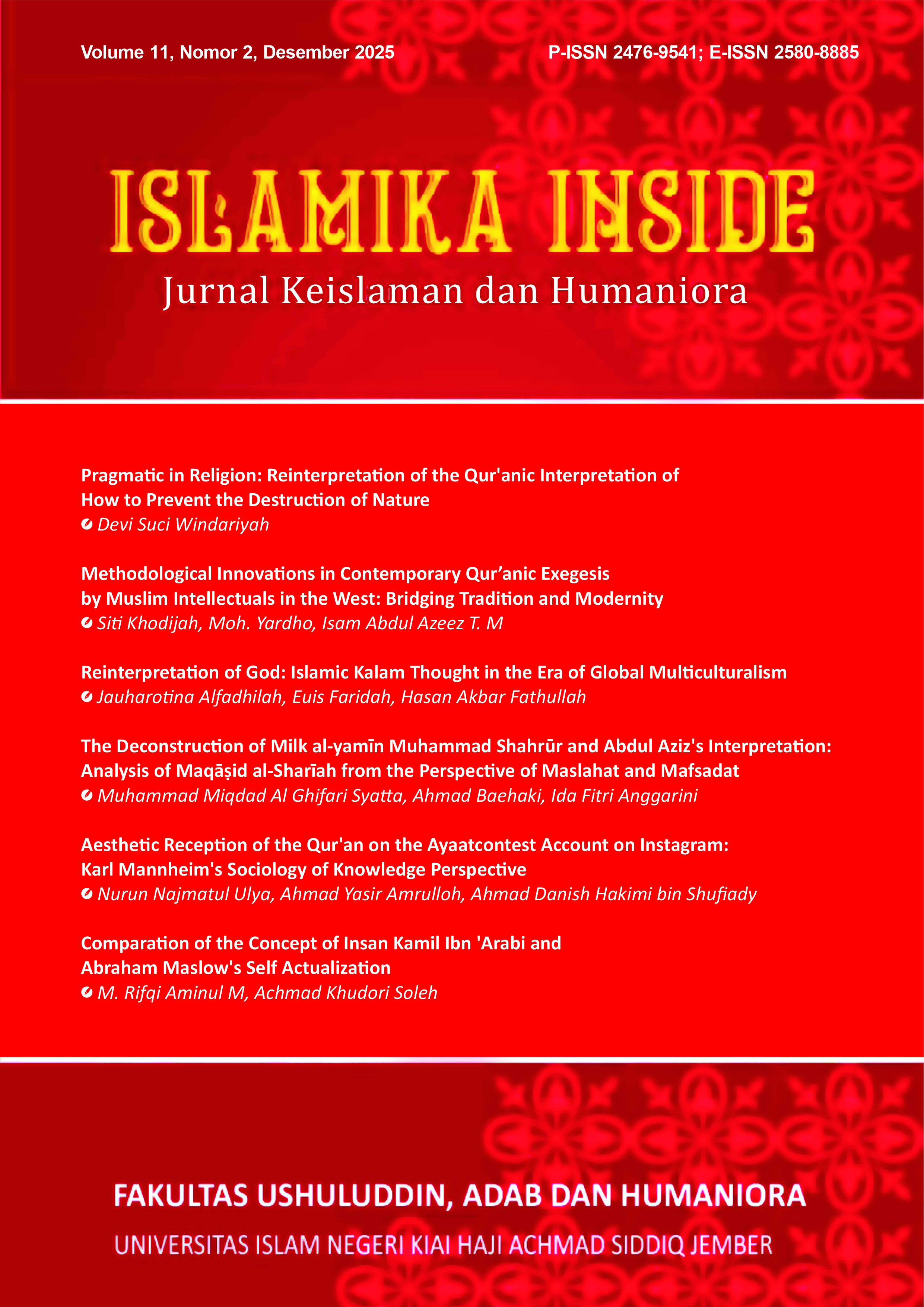
Pragmatic in Religion: Reinterpretation of the Qur'anic Interpretation of How to Prevent the Destruction of Nature
DOI:
https://doi.org/10.35719/islamikainside.v11i2.298Keywords:
pragmatics, Qur'anic interpretation, speech act, nature destruction, ethicsAbstract
This is a study of speech act analysis as part of pragmatic studies contained in the interpretation of the Qur'an by Ibn Kathir. In the Qur'an, Surah Al-Rum, verse 41, contains a reference to the seeming corruption on earth. The purpose of this study is to analyse the speech acts of Ibn Kathir's interpretation of natural damage, the factors that cause natural damage on earth, and the implications of speech acts (pragmatic) in Qur'anic studies. The results showed that the illocution contained in the interpretation of Ibn Kathir is assertive and directive. From the classification of speech acts, it is found that the factors that can cause natural damage are human sin and the loss of one's belief in God's supernatural power. The Pragmatic Implications of Ibn Kathir's interpretation are: affirmation of logical pragmatics, rejection of dualism, context and variability, interaction and negotiation, and implications for Comparative Ethics.
References
’Asakir, Ibnu. “Tarikhu Dimasyqa.” In 22, 191. Dar al Fikri, 1995.
Abdul-Raof, H. Qur’an Translation: Discourse, Texture and Exegesis. London: Routledge, 2001.
Ad-Dzahabi. Siyaru Aʼlami An-Nubal, Juz IV. Dar al Had. Kairo, 2006.
Adapa, Jyothsna Devi, and Keesara Venkatareddy. “Drought Analysis of an Area Using Google Earth Engine.” In Lecture Notes in Civil Engineering, 123–41, 2024.
AI-Hilali, Taqi-ud-Din, and Muhammad Muhsin Khan. Translation of the Meanings of The Noble Qur’an In The English Language. Madinah: KING FAHD COMPLEX FOR THE PRINTING OF THE HOLY QUR’AN, 1984.
Al-Aadili, Nesaem Mehdi. “A Pragmatic Approach to Translating Speech Acts in Religious Discourse.” Al Ameed Journal 12, no. 46 (2023): 273–94. https://doi.org/10.55568/amd.v12i46.273-294.
Al-Ghazali, Abdul Hamid. Ihya’ Ulum Al-Din. Damaskus: Dar al Fikri, 2007.
Al-Heeh, Dr. Sami. “Revisiting What Is Termed as Anomalous Formulaic Expressions in the Qur’anic Discourse: A Cognitive Study from a Pragma-Stylistic Perspective.” Middle East Research Journal of Linguistics and Literature 1, no. 1 (2021): 18–32. https://doi.org/10.36348/merjll.2021.v01i01.004.
Belzen, Jacob A. “A Hermeneutical, Interdisciplinary Approach to the Study of Religion.” In Towards Cultural Psychology of Religion, 2010. https://doi.org/10.1007/978-90-481-3491-5_2.
Chaer, Abdul, and Leonie Agustina. Sosiolinguistik Perkenalan Awal. Jakarta: Rineka Cipta, 2010.
Danyluck, Chad, and Elizabeth Page-Gould. “Social and Physiological Context Can Affect the Meaning of Physiological Synchrony.” Scientific Reports 9, no. 1 (2019): 1–13. https://doi.org/10.1038/s41598-019-44667-5.
Davis, G. Scott. “The Pragmatic Turn in the Study of Religion.” Journal of Religious Ethics 33, no. 4 (2005): 659–68. https://doi.org/10.1111/j.1467-9795.2005.00243.x.
Hani, Maha, Zaidan Hashim, and Aliwy Mohammed. “A Pragmatic Approach to Translating Speech Acts in Religious Discourse.” Education College Journal, 2019.
Hassan, Hassan Badr. “A Pragmatic Analysis: Implications of Lexical Choices in Translating Quranic Rhetoric.” Advances in Language and Literary Studies 11, no. 3 (2020): 1. https://doi.org/10.7575/aiac.alls.v.11n.3p.1.
Hidayat, Komarudin. “Agama Dan Kegalauan Masyarakat Modern” Dalam Nurcholish Madjid (Ed), “Kehampaan Spiritual Masyarakat Modern,.” Jakarta: Mediacita, 2022.
Johnson, Dominic D. P. “God’s Punishment and Public Goods.” Human Nature 16, no. 4 (2005): 410–46. https://doi.org/10.1007/s12110-005-1017-0.
Kalantari, Ibrahim. “Quran Objective Solutions to Meet the Needs of Modern Man.” Review of European Studies 9, no. 2 (2017): 286. https://doi.org/10.5539/res.v9n2p286.
Khalaf, Abed Shahooth, Ayad Hamad Ali, Fatin Khalil Ibraheem, and Sabariah Md Rashid. “Morphopragmatic Analysis of Word Derivation Variations in the Holy Quran and Their Translations into English.” Dirasat: Human and Social Sciences 50, no. 6 (2023): 45–60. https://doi.org/10.35516/hum.v50i6.7034.
Khan, Ramla, and Hammad Gilani. “Global Drought Monitoring with Big Geospatial Datasets Using Google Earth Engine.” Environmental Science and Pollution Research 28, no. 14 (2021): 17244–64. https://doi.org/10.1007/s11356-020-12023-0.
Khazaleh, Hekmat Abed Daifallah, Ahmad Arifin Sapar, and Jariah Mohd Jan. “A Pragmatic Analysis of the Speech Act of Supplication in the Holy Quran.” Al-Dad Journal 7, no. 1 (2023): 40–53.
Mastroianni, Adam M, and Daniel T Gilbert. “The Illusion of Moral Decline.” Nature 618, no. June (2023). https://doi.org/10.1038/s41586-023-06137-x.
Racine, Eric. “Interdisciplinary Approaches for a Pragmatic Neuroethics.” American Journal of Bioethics 8, no. 1 (2008).
Rahardi, R. Kunjana. Pragmatik: Kesantunan Imperatif Bahasa Indonesia. Jakarta: Erlangga, 2005.
Shuliak, I. M. “PRAGMATIC TRANSPOSITION OF SPEECH ACTS IN ENGLISH DISCOURSE.” Lviv Philological Journal, no. 6 (2019).
Sulistyo, Edi Tri. Pragmatik Suatu Kajian Awal. Semarang: Universitas Sebelas Maret, 2003.
Tweed, Thomas A. “The Interdisciplinary Study of Geography and Religion: A Pragmatic Approach.” Revista Relegens Thréskeia 3, no. 2 (2014): 01. https://doi.org/10.5380/rt.v3i2.39093.
Downloads
Published
How to Cite
Issue
Section
License
License and Copyright
Authors who publish in this journal agree to the following terms:
- Authors retain copyright and grant the journal right of first publication with the work simultaneously licensed under a Creative Commons Attribution-ShareAlike 4.0 International License that allows others to share the work with an acknowledgement of the work's authorship and initial publication in this journal.
- Authors are able to enter into separate, additional contractual arrangements for the non-exclusive distribution of the journal's published version of the work (e.g., post it to an institutional repository or publish it in a book), with an acknowledgement of its initial publication in this journal.
- Authors are permitted and encouraged to post their work online (e.g., in institutional repositories or on their websites) prior to and during the submission process, as this can lead to productive exchanges and earlier and greater citation of published work.
Read more: License and Copyright